
What Is Floor Mastic? A Complete Guide to Understanding This Common Flooring Adhesive

Walk into almost any building constructed before 1980 and there is a good chance the floors are held together — or were once held together — by a substance most people have never thought about: floor mastic. Hidden beneath tile, linoleum, hardwood, and carpet, floor mastic is one of the most widely used and least understood construction materials in the history of American building. Understanding what it is, where it comes from, and why it matters is essential knowledge for anyone involved in flooring installation, renovation, or historic building work.
What Is Floor Mastic?
Floor mastic is a thick, adhesive compound used in the construction and flooring industries to bond floor coverings — tile, stone, hardwood, and other materials — to subfloor surfaces. The word “mastic” derives from the Greek mastichon, referring to the resin of the mastic tree, though modern floor mastics bear little chemical relationship to that ancient botanical substance. Today the term refers broadly to any heavy-duty, paste-like adhesive used in flooring applications.
Floor mastic is distinctly different from thin-set mortar — the cement-based adhesive most commonly used for ceramic and porcelain tile installation today. Where thin-set is a rigid, water-based mortar that cures through a chemical reaction, mastic is an organic, petroleum- or latex-based adhesive that bonds through drying and solvent evaporation. This distinction has significant practical implications: mastic remains slightly flexible after curing, making it more forgiving of minor subfloor movement but also less suitable for wet areas where moisture can reactivate the bond.
The History of Floor Mastic
Floor mastic has been used in American construction since the late 19th century, but its golden age was the mid-20th century — roughly the 1920s through the 1970s — when it became the dominant adhesive for installing the vinyl composition tiles, asphalt tiles, and linoleum that floored millions of American homes, schools, hospitals, and commercial buildings.
During this period, mastic was valued for its extraordinary bonding strength, its flexibility, its resistance to moisture, and its ease of application. It spread smoothly with a notched trowel, had a long open time that allowed workers to position tiles carefully, and created a durable bond that — as the buildings still standing today demonstrate — could last for decades.
The formulations used during this era, however, contained ingredients that would later become subjects of serious public health concern — most significantly, asbestos fibers and various petroleum-based solvents. Understanding those historical formulations is essential for anyone working with older floors today.

Types of Floor Mastic
Modern and historical floor mastics fall into several distinct categories, each with different chemical compositions, applications, and performance characteristics.
Organic Mastic (Type 1 Mastic)
Organic mastic — sometimes called Type 1 mastic or cutback mastic — is a petroleum-based adhesive that dominated the flooring industry from the early 20th century through the 1970s. It is composed primarily of asphaltic or coal tar derivatives dissolved in petroleum solvents, creating the thick, dark, highly adhesive compound that was applied across millions of square feet of American floors during that era.
Organic mastic is extraordinarily durable — its petroleum base resists moisture, biological degradation, and mechanical stress with remarkable tenacity. Floors bonded with organic mastic generations ago often remain stubbornly adhered today, resistant to removal even with significant mechanical force. This durability, once considered a virtue, creates significant challenges for renovation work on older buildings.
The significant limitation of organic mastic is its inability to perform in genuinely wet conditions. While resistant to occasional moisture exposure, sustained water contact can soften and reactivate the bond, making it unsuitable for shower installations, areas subject to flooding, or exterior applications.
Latex Mastic (Type 2 Mastic)
Beginning in the 1970s and accelerating through the 1980s and 1990s, latex-based mastics began replacing organic petroleum-based formulations. Latex mastic uses synthetic rubber polymers as its primary binder, offering strong adhesion with a significantly reduced solvent content and a more environmentally friendly profile than petroleum-based predecessors.
Modern latex mastics are water-based, low-VOC, and free of the hazardous ingredients that characterized earlier formulations. They are widely used today for installing vinyl tile, luxury vinyl plank, cork flooring, and certain wood flooring applications. However latex mastic shares organic mastic’s primary limitation: it is not suitable for wet areas. When exposed to sustained moisture, latex mastic can soften, lose adhesion, and allow tiles or planks to shift — a failure mode that has led many flooring professionals to prefer thin-set mortar for any installation with moisture exposure.
Epoxy Mastic
Epoxy-based mastics represent the premium tier of flooring adhesives — two-component systems that cure through a chemical reaction between a resin and a hardener rather than through solvent evaporation. Epoxy mastics offer extraordinary bond strength, chemical resistance, and moisture resistance, making them suitable for industrial applications, chemical processing facilities, and other demanding environments where standard mastics would fail.
Epoxy mastics are significantly more expensive and technically demanding to apply than standard organic or latex mastics, limiting their use to specialized applications where their superior performance justifies the additional cost and complexity.
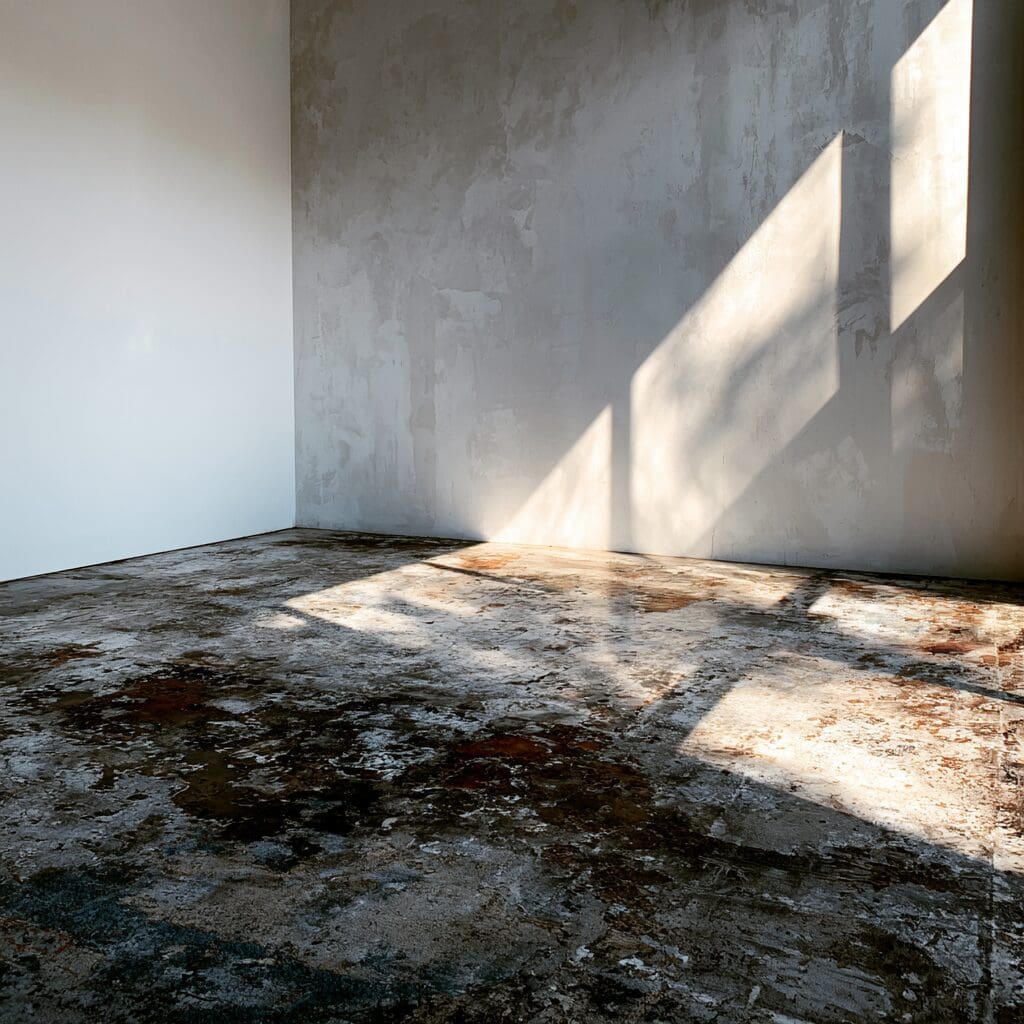
Black Mastic — The Most Notorious Floor Adhesive in American Construction
Of all the floor mastics ever produced, none is more widely recognized — or more widely feared — than black mastic: the dark, tar-like adhesive that appears beneath countless floors in American buildings constructed before 1980.
What Is Black Mastic?
Black mastic is the informal name for cutback adhesive — an organic, asphaltic floor adhesive that was manufactured and applied in enormous quantities from the 1920s through the late 1970s. Its characteristic dark brown to jet-black color comes from its primary ingredient: asphalt, a petroleum-derived bituminous material also used in road paving and roofing. The term “cutback” refers to the manufacturing process in which solid asphalt is “cut back” — dissolved and thinned — with petroleum solvents to create a workable adhesive consistency.
Black mastic was used almost universally for installing the 9×9 inch and 12×12 inch vinyl asbestos tiles, asphalt tiles, and linoleum that characterized mid-century American interior flooring. Walk into a school, hospital, office building, or home built between 1940 and 1975 and there is an excellent chance that black mastic is present beneath the finished floor surface — whether that surface has been updated or not.
Why Black Mastic Matters — The Asbestos Issue
The reason black mastic commands such serious attention in renovation and demolition work today is its historical association with asbestos. Many black mastic formulations produced before the late 1970s contained asbestos fibers added to improve the adhesive’s strength, heat resistance, and durability. This was standard industry practice — asbestos was widely used in construction materials throughout this era before its health hazards were fully understood and regulatory action followed.
The danger profile of asbestos-containing black mastic follows the same pattern as other asbestos-containing materials: when left undisturbed and in good condition, it generally poses minimal immediate risk because the asbestos fibers are bound within the adhesive matrix and cannot become airborne. The danger arises when the mastic is disturbed — scraped, ground, sanded, or mechanically removed — releasing microscopic asbestos fibers that can remain suspended in air for extended periods and be inhaled deeply into the lungs.
Long-term asbestos fiber inhalation is associated with mesothelioma, asbestosis, and lung cancer — diseases with long latency periods that may not manifest until decades after initial exposure. For this reason, regulatory agencies including the EPA and OSHA have established strict protocols for working with materials that may contain asbestos, including black mastic.
Identifying Black Mastic
Black mastic is visually distinctive and relatively easy to identify by its characteristic appearance:
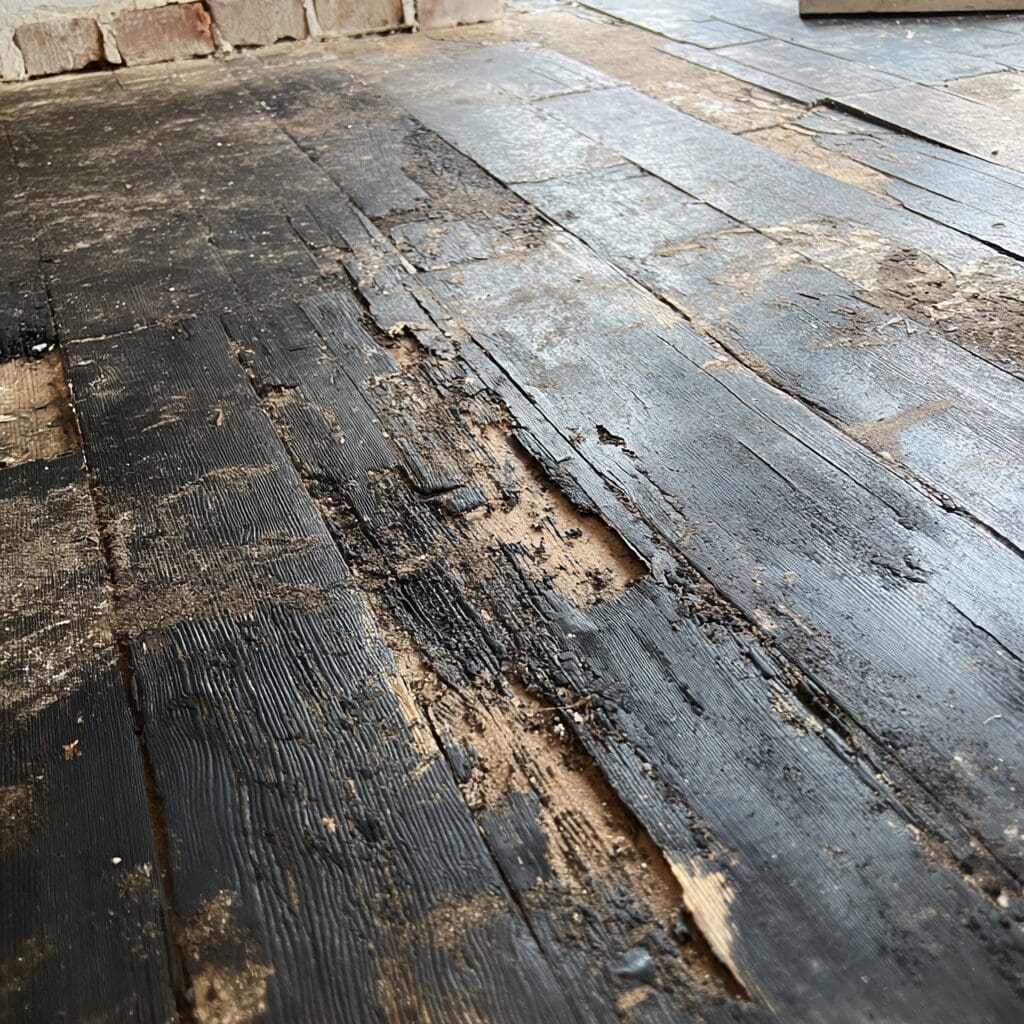
The adhesive is typically dark brown to jet black in color — a reflection of its asphaltic base. It has a tar-like consistency when fresh but becomes increasingly brittle and hard with age, though it may soften again with heat or solvent exposure. It is most commonly found in a notched trowel application pattern — the ridges left by the trowel teeth may be visible where tiles have been removed, creating a distinctive corduroy-like texture across the subfloor surface.
The most common locations for black mastic include beneath vinyl and asphalt floor tiles in residential and commercial buildings from the mid-20th century, particularly in basements, kitchens, bathrooms, schools, hospitals, and institutional buildings from the same era.
However — and this is critically important — you cannot confirm whether black mastic contains asbestos through visual inspection alone. The only reliable method of determination is laboratory analysis of a properly collected sample by a certified asbestos testing laboratory.
Working Safely with Black Mastic
The discovery of black mastic in a renovation project requires a careful and considered response:
Do not disturb it without testing. The first and most important rule is to leave the material completely intact until its asbestos content has been determined. Collect a sample — or have a certified asbestos inspector collect one — and have it analyzed by an accredited laboratory before any removal or disturbance activity begins.
Consider encapsulation over removal. When black mastic tests positive for asbestos and is in stable condition, encapsulation — covering it with new flooring rather than removing it — is frequently the most practical, cost-effective, and safest approach. Many flooring types can be installed directly over stable black mastic without disturbance, effectively sealing the material and eliminating exposure risk.
Require licensed abatement for removal. When removal is necessary — due to deteriorating condition, planned demolition, or specific renovation requirements — it must be performed by licensed asbestos abatement contractors following strict regulatory protocols including containment of the work area, use of appropriate personal protective equipment, air monitoring, and proper disposal of all asbestos-containing waste.
Never grind, sand, or scarify. These mechanical removal methods are particularly dangerous when asbestos-containing black mastic is present because they pulverize the material into fine dust, releasing the maximum possible quantity of airborne fibers. Even when asbestos content has not been confirmed, these methods should be approached with extreme caution in buildings of the relevant era.
Modern Floor Mastic — Current Applications and Performance
Contemporary floor mastic — the water-based, latex formulations available today — bears little resemblance to the asphaltic compounds of the mid-20th century. Modern mastics are engineered for specific flooring applications and have well-defined performance parameters that guide their appropriate use.

When Modern Mastic Is the Right Choice
Modern latex mastic excels in several specific applications:
Luxury Vinyl Plank and Tile (LVP/LVT) — Many floating LVP installations use mastic for glue-down applications, where its flexibility accommodates the slight movement inherent in vinyl flooring without cracking the adhesive layer.
Cork Flooring — Cork’s natural flexibility makes mastic a better adhesive choice than rigid thin-set, allowing the flooring to expand and contract with humidity changes without bond failure.
Wood Parquet and Engineered Hardwood — Certain wood flooring applications use mastic for its flexibility and gap-bridging properties on slightly uneven subfloors.
Dry Interior Areas — Any tile or flooring installation in genuinely dry interior spaces where moisture exposure is not a concern.
When Modern Mastic Is the Wrong Choice
Understanding mastic’s limitations is as important as understanding its appropriate uses:
Wet areas — Showers, steam rooms, areas subject to flooding, or any installation below grade where moisture can migrate through the slab are inappropriate applications for mastic. Sustained water exposure will reactivate latex mastic, compromising the bond and allowing tiles to shift, crack, or detach.
Large format tile — Heavy large-format ceramic or porcelain tile requires the superior mechanical bond of thin-set mortar. Mastic’s flexibility, which is an asset in some applications, becomes a liability under the weight of large heavy tiles — allowing micro-movement that can crack grout joints and eventually the tiles themselves.
Exterior applications — Mastic is formulated for interior use. Exterior temperature cycling, UV exposure, and moisture contact will rapidly degrade any standard mastic formulation.
Heated floors — Radiant heat systems beneath tile flooring can soften and reactivate mastic over time, making thin-set the only appropriate adhesive choice for these installations.
Removing Floor Mastic — Methods and Considerations
Whether dealing with historic black mastic or failed modern adhesive, mastic removal is one of the most challenging tasks in flooring work. The extraordinary bonding strength that makes mastic so effective as an adhesive makes it correspondingly resistant to removal.
Mechanical Removal
Floor scrapers, ride-on scarifiers, and angle grinders with appropriate attachments can remove mastic mechanically — but these methods require significant caution in older buildings where asbestos content has not been ruled out. Mechanical removal generates dust and debris that must be carefully managed, and the heat generated by grinding or scarifying can potentially release volatile compounds from petroleum-based mastics.
Chemical Removal — Citrus-Based Solvents
Chemical mastic removers offer a less aggressive alternative to mechanical methods — particularly valuable in situations where mechanical methods risk surface damage or asbestos disturbance. Citrus-based mastic removers — powered by d-limonene extracted from orange peel — have become increasingly popular for their ability to soften and dissolve asphaltic and latex mastics without the toxicity of traditional petroleum-based solvents.
D-limonene penetrates mastic at a molecular level, breaking down the asphaltic and polymer binder compounds that give mastic its adhesive properties. Applied generously and allowed to dwell for the manufacturer’s recommended period — typically 20 to 60 minutes for heavy mastic deposits — citrus remover softens the mastic sufficiently to be scraped away with significantly less mechanical force than would otherwise be required.
The advantages of citrus-based mastic removers extend beyond chemical effectiveness: they are biodegradable, non-carcinogenic, and can be used in occupied or semi-occupied spaces with basic ventilation — a significant advantage over traditional solvent-based removers that require full respiratory protection and extensive ventilation. They are also safe on concrete subfloors, leaving no chemical residue that could interfere with new adhesive or coating applications after cleanup.
Encapsulation
For stable historic black mastic — particularly when asbestos content has been confirmed or is suspected — encapsulation through overlay with new flooring is frequently the most practical and safest approach. Modern self-leveling underlayment products can be poured over stable mastic to create a smooth, flat surface for new flooring installation. This approach eliminates disturbance of the existing material, avoids the cost and complexity of abatement, and produces a high-quality finished floor surface.
Conclusion
Floor mastic is one of those building materials that exists entirely beneath notice until something goes wrong — a renovation, a demolition, a damaged floor that needs replacement. At that point, understanding what you’re dealing with becomes genuinely important: whether it’s a modern latex mastic that simply needs the right solvent to remove, or a historic black mastic that may contain asbestos and requires careful, compliant handling.
The essential principles are consistent regardless of the type of mastic encountered: identify before disturbing, test before removing if there is any possibility of asbestos content, choose removal methods appropriate to the material and the situation, and when in doubt consult a qualified flooring or environmental professional. The mastic that held your building together for fifty years deserves to be treated with the same care and respect that its extraordinary durability suggests it was designed for.
If you suspect asbestos-containing materials in your building, always consult a certified asbestos inspector before beginning any renovation or demolition work. Your health and the health of those around you depends on informed, compliant handling of these materials.